

Anya Allen, Juhi Bhatt, William Deklich, Zijun He , Jameson Palmer, Samuel Thomas, Mina Uzgoren
NASA SEES Exoplanet Transits Team Mentor: Thomas Rutherford
Introduction
Ever since the discovery of exoplanets around PSR B1257+12 in 1992, exoplanetary science has given rise to multiple what-ifs about the universe. Exoplanets are an incredible source of historical information about stellar systems, and they hold the key to understanding planet formation, the distribution of various types of substellar bodies, and even the likelihood of life’s existence on other worlds. To examine and research these incredible aspects of astronomy, however, scientists must first characterize both the Orbital Parameters (Inclination, Semi-Major Axis, Eccentricity, etc.) and Physical Parameters (Planetary Radius, Mass, Density, etc.) of each exoplanet discovered. One of the best exoplanet detection methods to accomplish this is the Transit Method: Minute dips in a star’s brightness (due to an exoplanet’s path obscuring said star) allow scientists to extract these crucial parameters and thoroughly research the endless possibilities that exoplanetary science holds.
Methodology
The original scope of the NASA SEES Exoplanetary Transit Research Project involved only one Transit Method parameter extraction technique. However, for both redundancy and additional versatility, a second methodology was introduced. Both methodologies are described below:
Methodology 1: HOlomon Photometric Software (HOPS)
- HOPS is an exoplanetary modeling software and specialized astronomy tool for precise photometric observations (Tsiaras, 2021).
- It analyzes tens to hundreds of full-frame images from ground-based or space-based telescopes.
- HOPS performs Aperture Photometry, which measures the brightness of a star.
- It compares multiple reference stars to track the target star’s brightness over time.
- These data produce a light curve through aperture photometry analysis.
- The light curve is fitted using the Markov-Chain Monte Carlo (MCMC) method.
- The final result is a list of the exoplanet’s orbital and physical parameters.
Methodology 2: BAsic Transit Model cAlculatioN
- In addition to HOPS, our team used other transit fitting algorithms beyond the internship’s original scope. For this, the BAsic Transit Model cAlculatioN (BATMAN) software was chosen (Kreidberg, 2015).
- BATMAN is a light curve fitting software introduced by Laura Kreidberg in 2015.
- Its light curves use set orbital and physical parameters (eccentricity, inclination, planetary radius, etc.).
- When used with a fitting algorithm — in this case, Markov-Chain Monte Carlo (MCMC) — BATMAN has the potential to extract key exoplanetary parameters.
Analyzed Exoplanet Candidates
The SEES Exoplanet Transits Team was given 11 candidates to analyze using HOPS:
- WASP-41b: Hot Jupiter; shows stellar activity effects.
- WASP-19b: Hot Jupiter; ultra-short 0.79-day orbit.
- WASP-135b: Hot Jupiter; tight orbit, tidal studies.
- CoRoT-1b: Hot Jupiter; first confirmed by CoRoT.
- Kepler-41b: Hot Jupiter; helped refine albedo models.
- TrES-5b: Hot Jupiter; orbits a faint star in Cygnus.
- KELT-23 A b: Hot Jupiter; bright star, JWST target.
- HATS-18 b: Hot Jupiter; very short period, tidal spin-up.
- TOI-674b: Warm Neptune; low density, puffy atmosphere.
- TOI-540b: Neptune-sized; orbits a cool red dwarf.
- TOI-519b: Giant planet; rare gas giant around M dwarf.
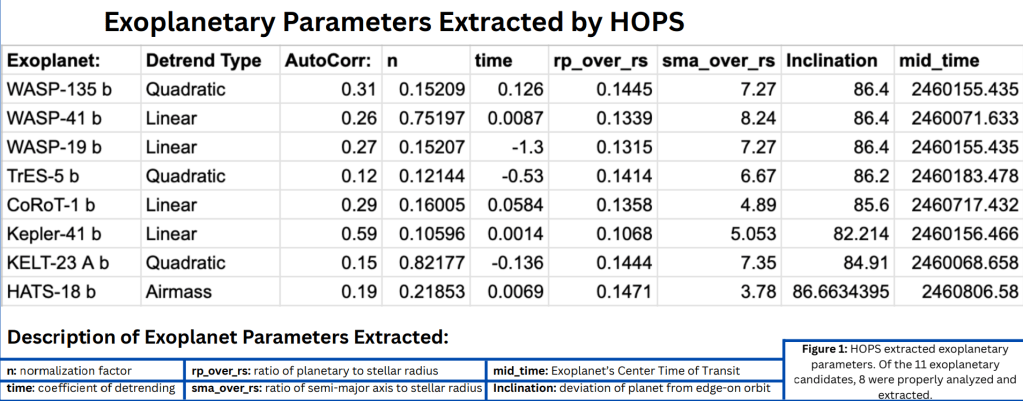
Of these eleven, eight were analyzed using HOPS, while all were analyzed using BATMAN. TOI-674b, TOI-519b, and TOI-540b were analyzed using BATMAN specifically due to errors encountered when fitting with HOPS.
Datasets Employed in Exoplanetary Analysis
Data from the Southeastern Association for Research in Astronomy (SARA) Telescope in Cerro Tololo, Chile. It is a 0.6-meter telescope that ensures all astronomy institutions can have access to quality telescope data.
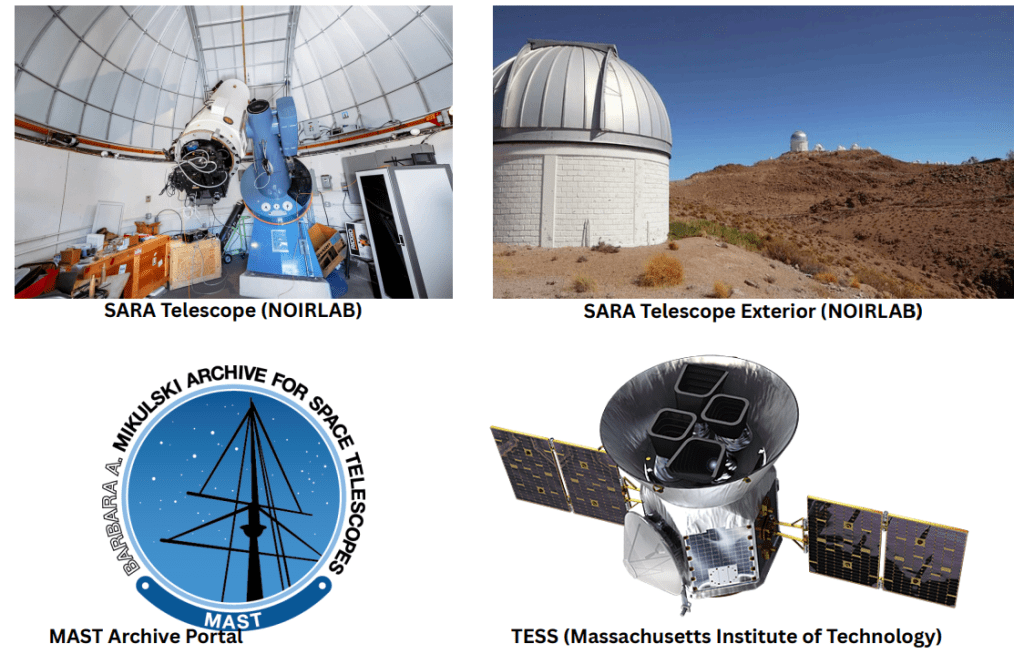
Data from the Mikulski Archive for Space Telescopes (MAST) Archive Portal. The datasets taken were from the Transiting Exoplanet Survey Satellite (TESS), a space telescope designed to capture transiting exoplanets around stellar systems.
HOPs Results
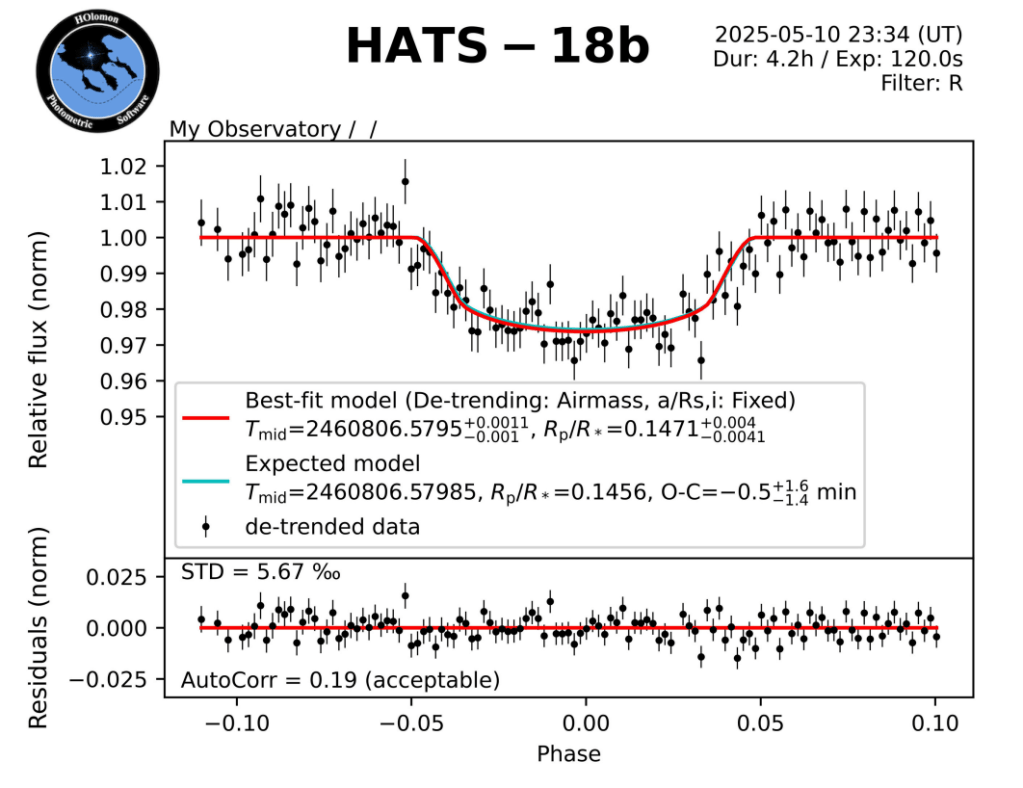
Issues Encountered with HOPS:
When fitting using HOPS, certain exoplanet candidates either failed to achieve a good fit or simply could not
be fitted using HOPS software. When this issue occurs, the second method, utilizing a BATMAN light curve
model coupled with a Markov-Chain-Monte-Carlo fitting algorithm, can extract the orbital and physical
parameters that HOPS can not.
BATMAN Results
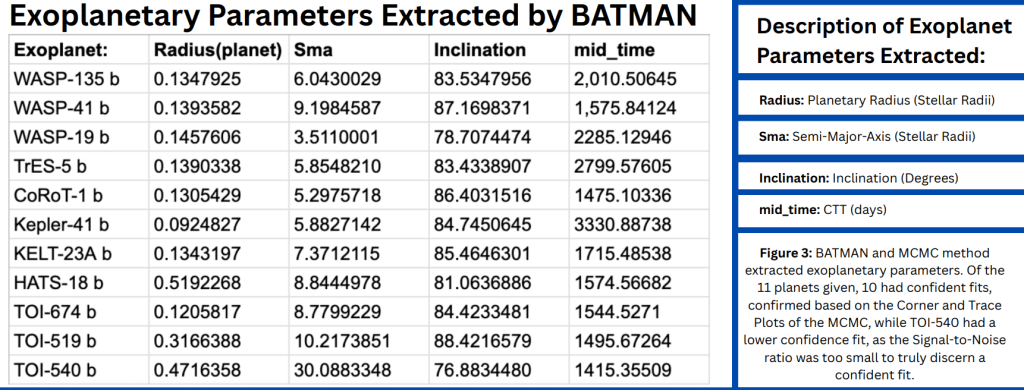
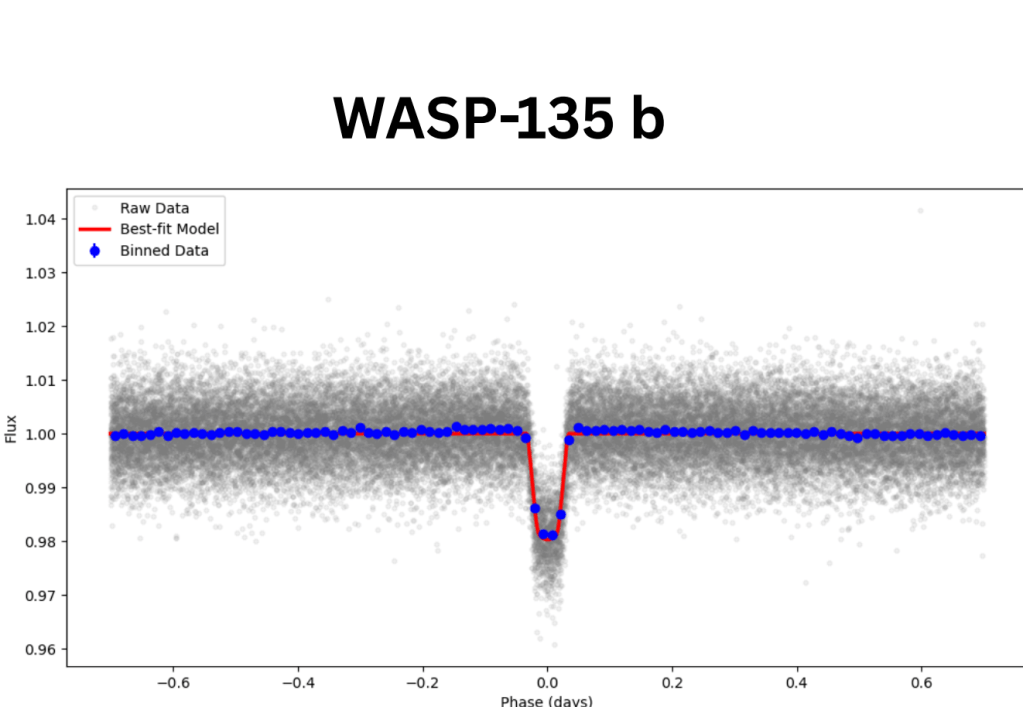
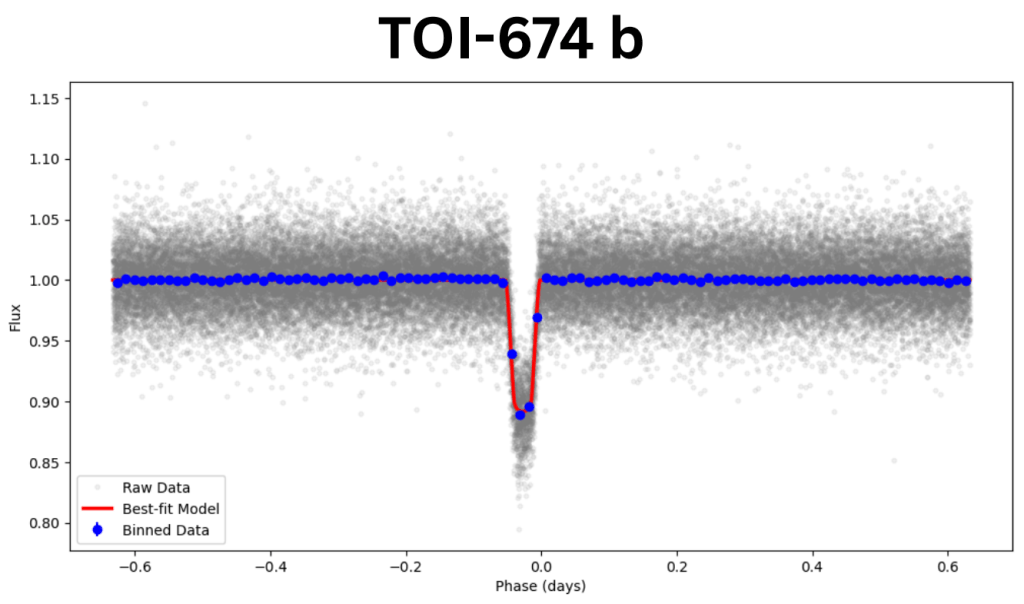
Comparison Between HOPS and BATMAN:
The HOPS method and the BATMAN method are two valid methods for analyzing and extracting exoplanetary parameters from light curve data. Both have their pros and cons as listed bellow:
- HOPS is more user-friendly than BATMAN
- BATMAN requires a deeper understanding of the programming language.
- HOPS takes more rudimentary target pixel files, while BATMAN requires light curves.
- BATMAN is more versatile than HOPS and allows for a wider range of exoplanetary fits.
- BATMAN typically takes a shorter amount of time and has a less convoluted methodology.
- BATMAN is typically more consistent with current literature, as it often outputs values that better match the exoplanetary parameters from the NASA Exoplanet Archive.
Discussion
Consistency of Values:
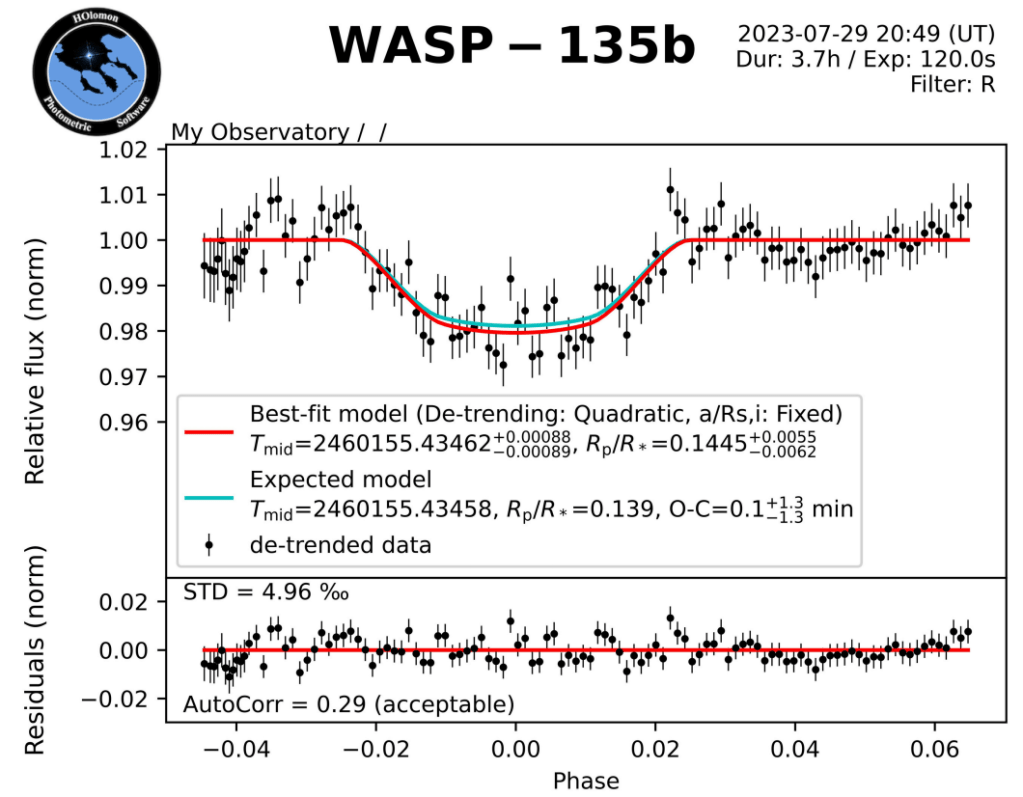
With the values derived by HOPS, one can clearly see that the fitting created by HOPS is consistent with the datapoints derived by the aperture photometry. In addition, the fitted parameters (Rp/Rs and n) are mostly consistent with previous observations within research papers (Spake et al. 2016 for WASP-135, Mislis et al.
2015 for TrES-5, etc.).
Significance of HOPS:
The consistency of parameter values between the HOPS software and the research developed by other scientists speaks to the efficacy of HOPS. It is Photometry Software that enables scientists and people at all career levels to perform significant research in the field of astronomy with less coding experience needed compared to a formal research process. In addition, HOPS executes the MCMC fitting algorithm at a quicker rate than standard MCMC algorithms coded by other scientists. This is extremely helpful in cutting down the amount of time spent running these simulations.
Drawbacks of HOPS:
HOPS is not without its flaws; however, frequent errors tend to cause the application itself to crash and stall. Furthermore, HOPS does not seem to work with certain exoplanets, most notably TOI-674b, TOI-540b, and TOI-519b. Therefore, although HOPS is faster and requires a low amount of programming knowledge while still outputting values consistent with previous literature, its frequent errors hinder its practical use in academia and astronomy as a whole.
HOPS vs. BATMAN, which fitting algorithm is more effective?
Between HOPS and BATMAN, both offer benefits and drawbacks. HOPS is more userfriendly and completes MCMC fits at a quicker rate while being prone to errors, whereas BATMAN takes longer and requires more programming knowledge, but is more versatile and flexible when dealing with light curves. Overall, the methodology chosen does not impact the final result to a significant degree. The user’s preference most affects this choice: If the user wants to obtain a quicker fit while risking errors, HOPS is the better option. However, if the user has more time and more knowledge, BATMAN may be the better choice.
Conclusion
Throughout the course of the NASA SEES Exoplanetary Transit Research Project, the HOPS software and BATMAN software were vetted against each other and used to derive the properties of exoplanet candidates with reasonable accuracy, with the exception of TOI-540b. This object’s transit could not be identified by either methodology. Because this exoplanet’s transit could not be reproduced, the Exoplanet Transits Team recommends further research into whether observations of this object truly constitute identification of an exoplanet
References
- Kokori, A. (2017). ExoWorlds Spies: Exoplanet science from your backyard! ExoWorlds Spies.
- Kreidberg, L. (2015). BATMAN: Basic transit model calculation in Python. Publications of the Astronomical Society of the Pacific, 127(957), 1161.
- Mikulski Archive for Space Telescopes (MAST) Portal. (n.d.). Mast.stsci.edu. NASA. (2019). NASA Exoplanet Archive. Caltech.edu.
- Speagle, J. S. (2019). A conceptual introduction to Markov chain Monte Carlo methods. arXiv preprint arXiv:1909.12313.
- Tsiaras, A. (2021). HOPS: a user-friendly data analysis software to open exoplanet research. In European Planetary Science Congress (pp. EPSC2021-602).

 Astronomer Willy
Leave a comment