
The Steven F. Udvar-Hazy Center (the Smithsonian’s National Air and Space Museum annex near Dulles) is the kind of place that recalibrates your sense of scale. It’s not a hallway of artifacts—it’s a working-sized hangar of milestones. Aircraft hang above you like they’re still in the pattern. Space hardware sits at eye level with the quiet confidence of things that have already been tested by vacuum, fire, and time.
Two hangars, one big timeline
Udvar-Hazy is essentially two enormous experiences under one roof:
- The Boeing Aviation Hangar, where you’re surrounded by airframes. Experimental aircraft, airliners, military icons are mostly suspended in midair like a frozen formation.
- The Space Hangar, darker and more intimate, where the exhibits feel closer to “machines that went somewhere” rather than machines that flew around here.
The joy is moving between them and noticing the repeating themes: weight vs. strength, heat vs. materials, human limits vs. life-support systems.
Mars on a pedestal (and why it hits harder than you expect)
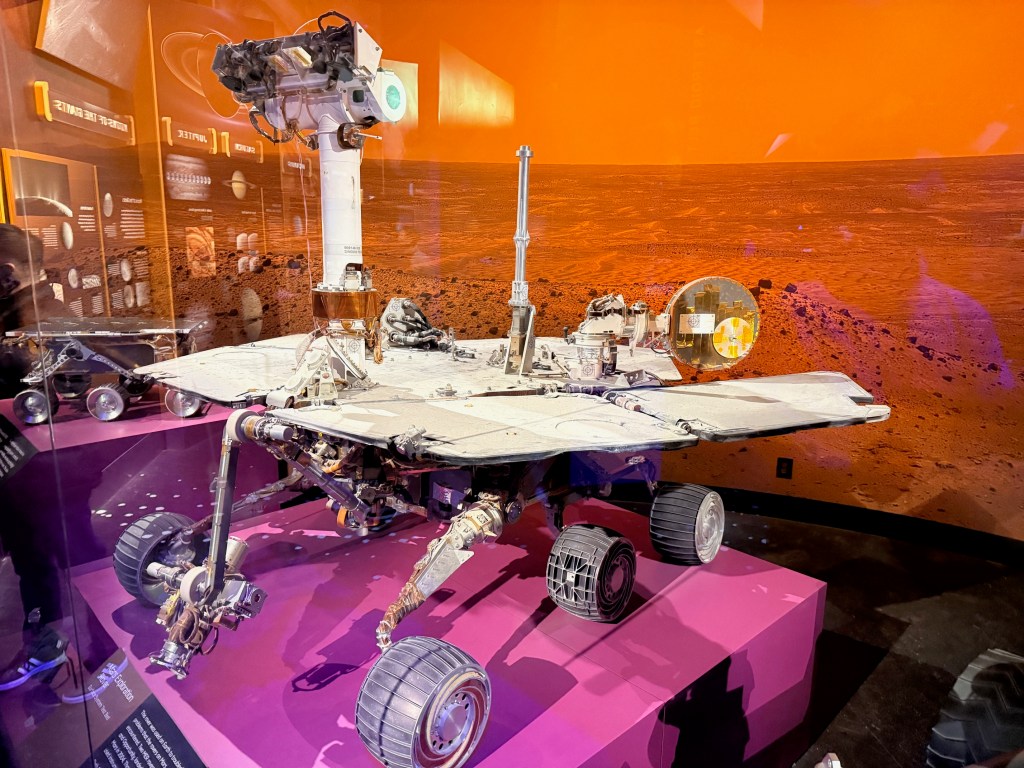
One of my favorite moments was stopping in front of the Mars rover display (a rover presented not as a toy like model), but as a real field machine: wide stance, rugged wheels, exposed mechanisms, and a mast of sensors like a periscope. The exhibit backdrop, drenched in Mars-orange, does something clever: it doesn’t try to make the rover “cool.” It makes it feel necessary.
The details are what linger. The tight packaging. The spare, purposeful geometry. Every bracket and joint whispers the same constraint: it has to work, far away, with no hands nearby to fix it.
It’s easy to romanticize Mars exploration as distant and cinematic. Standing there, it feels more like the world’s most expensive reliability test.
Gemini-era close quarters: the capsule that makes space feel small
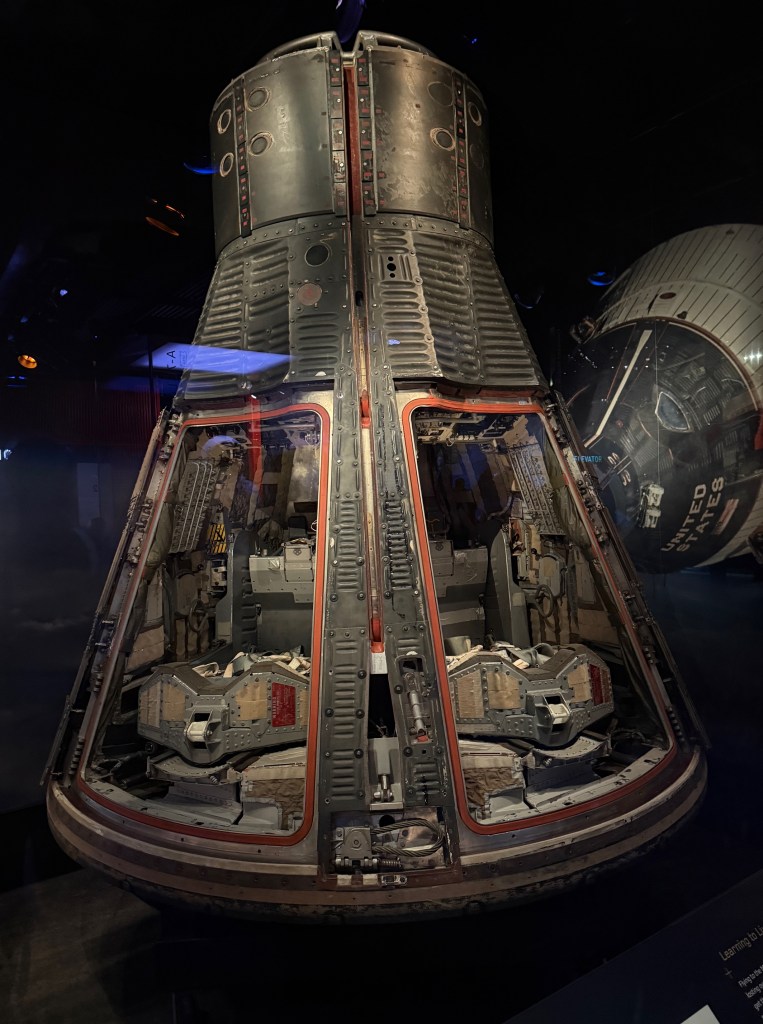
In the space galleries, the hardware has a particular honesty. A two-seat capsule (Gemini) sits there like a compact survival cell: dense panels, a narrow opening, and seats that look more like they belong in a test rig than a spacecraft.
Seeing it in person resets the mythology. We talk about “the Space Age” like it was sleek and spacious. But the early reality was this: tight volume, hard edges, and an overwhelming amount of control surfaces packed into a space barely larger than a closet.
The spacesuit:
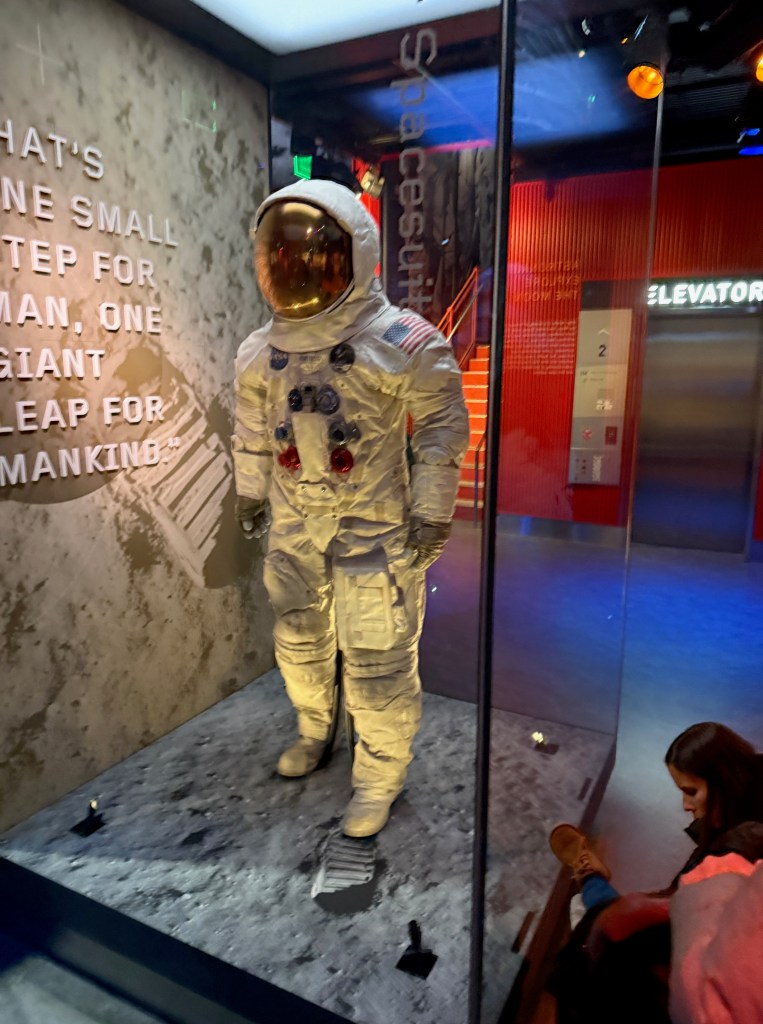
A spacesuit behind glass can look like a symbol of human achievement. Up close, it reads like equipment: layers, fittings, connectors, and the unmistakable bulk of something designed to keep a human alive where humans aren’t supposed to be. To think that Buzz landed with this on the moon blows my mind.
What struck me most is the suit’s contradiction: it’s protective, but it’s also a constraint. It provides an atmosphere and thermal control , while simultaneously limiting movement, dexterity, and comfort. It’s a wearable compromise between biology and physics.
The Moon, in hardware: roving, sampling, and making do
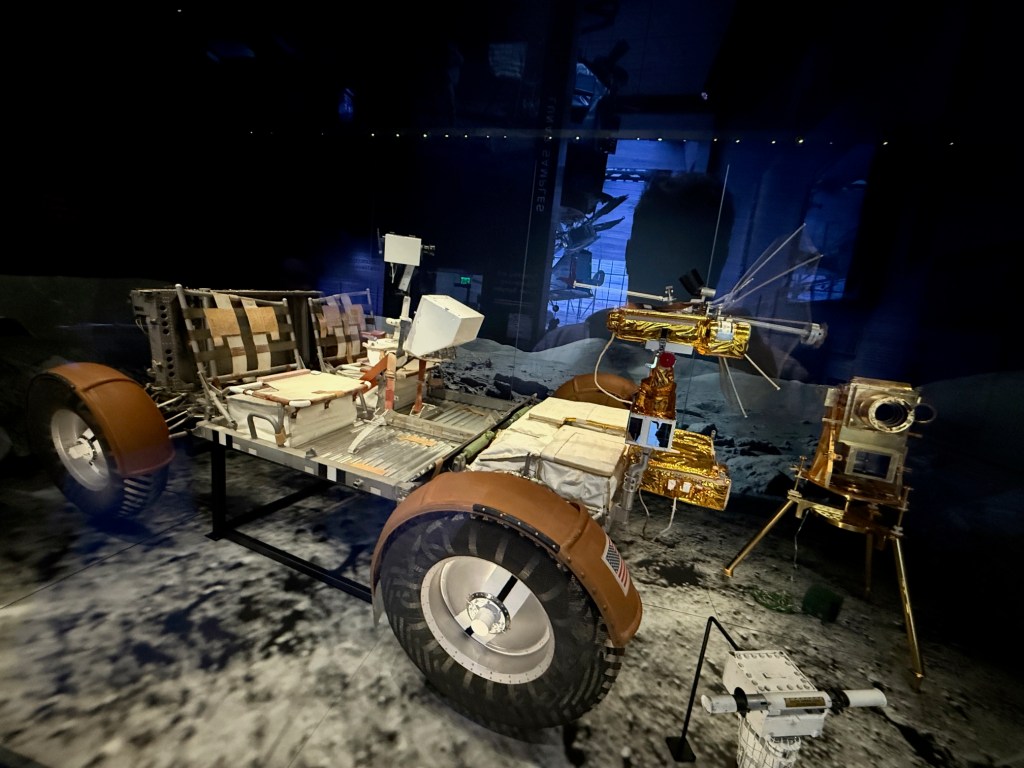
Another exhibit that stuck with me was the Moon buggy. Platform and instruments look almost improvised compared to modern spacecraft. Big wheels. Simple frames. Gold insulation catching the light. Tools and boxes arranged with the logic of fieldwork, not showroom design.
That’s what makes it powerful: it looks like something built by engineers who understood that exploration is rarely elegant. It’s practical. It’s modular. It’s meant to be used.
There’s a certain confidence in that simplicity. The message is: we didn’t wait for perfection, we built what we needed and went.
X-15: the bridge between “aircraft” and “spacecraft”
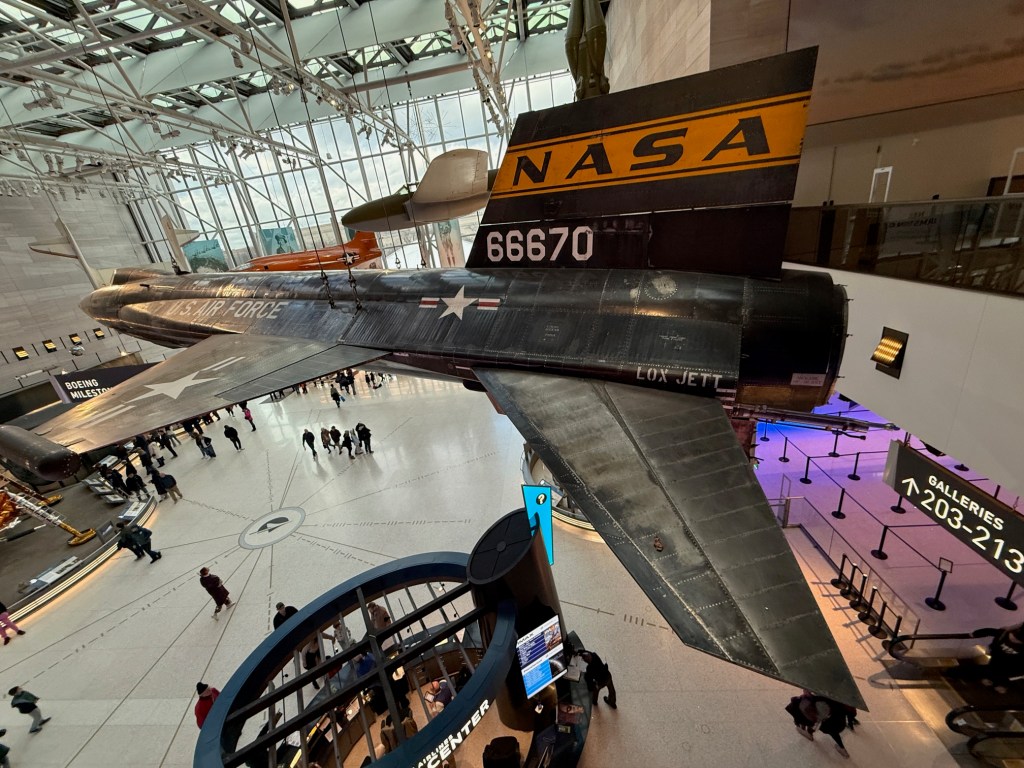
In the aviation hangar, one of the strongest “hinge points” in the whole museum is the NASA X-15. Hanging overhead, it doesn’t feel like a plane from a familiar lineage. It feels like an argument: that the atmosphere isn’t a boundary, it’s a gradient.
The X-15’s shape is pure function, its an experimental body made to tolerate heat, explore regimes, gather data, and come back. It sits right at that seam where aviation becomes astronautics: speed as a scientific instrument, not just a performance stat.
Seeing it suspended in the bright hangar light, you realize how much of the Space Age was built on aircraft thinking: test, iterate, measure. If it works, eventually it becomes rocket thinking.
SpaceShipOne: a reminder that the story kept going
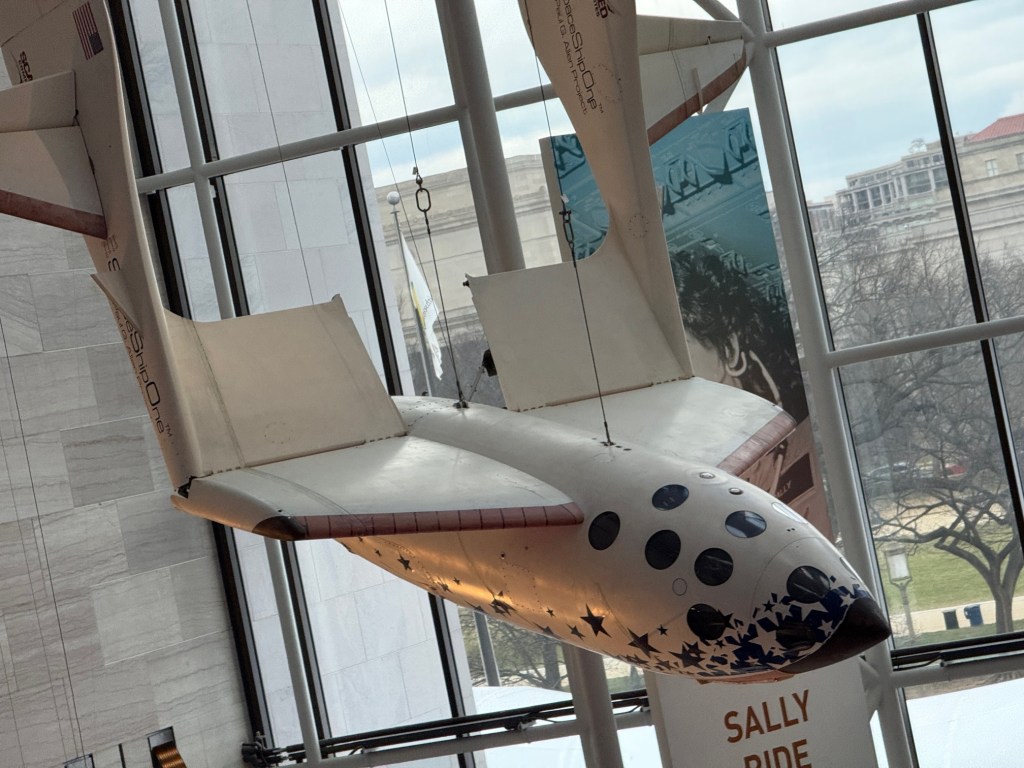
Nearby, SpaceShipOne hangs like a footnote that refuses to stay small. Compared to the grand narratives of Apollo and shuttle-era NASA, it represents something different: a modern shift toward experimental, privately-led approaches.
What I appreciated most about seeing it at Udvar-Hazy is the continuity. The museum doesn’t frame it as “old vs. new.” It frames it as another chapter in the same human habit: build a vehicle, push it into an extreme, learn what breaks, and try again.

 Astronomer Willy
Leave a comment