
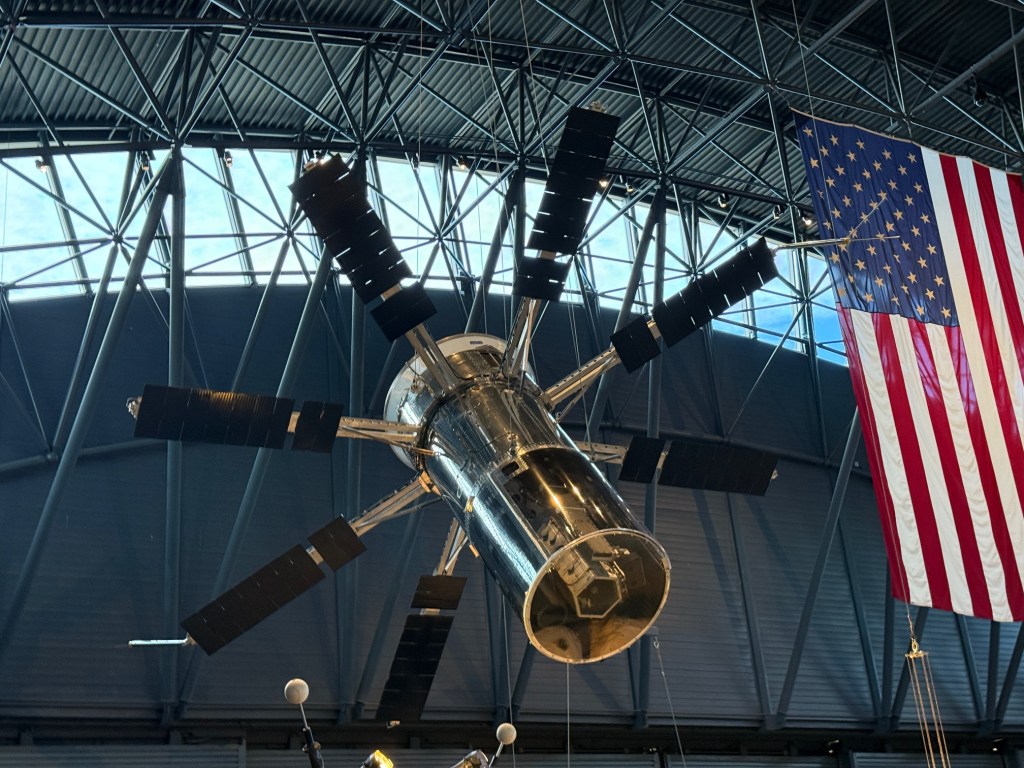
When people say “space capsule,” they usually mean the iconic blunt-bodied crew vehicles—tiny, tough, and built to survive re-entry. But walking through the National Air and Space Museum’s annex-style hangar experience (the kind where spacecraft are suspended overhead and you can see an orbiter tail in the same glance) reminds you that human spaceflight has always been part of a bigger ecosystem: satellites, probes, spacesuits, landers, and experimental aircraft that made exploration possible.
These photos capture that ecosystem. Here’s what we photographed—and what you’re likely looking at in each shot.
The “orbit zoo” above the hangar floor
This wide shot looks up into a ceiling filled with spacecraft of different eras and purposes—exactly the kind of display that makes you feel like you’re standing inside a time-lapse of the Space Age.
What’s visible:
- Multiple early satellite shapes: shiny spheres, drum-like bodies, and antenna “spider” designs—forms that were common when spacecraft were simpler, spin-stabilized, and power-limited.
- Solar panels in different styles: small rigid panels and larger arrays, showing how power generation evolved from modest experiments to mission-critical systems.
- A large American flag and, at the bottom edge, part of a space shuttle tail, grounding the whole scene in “this is real hardware.”
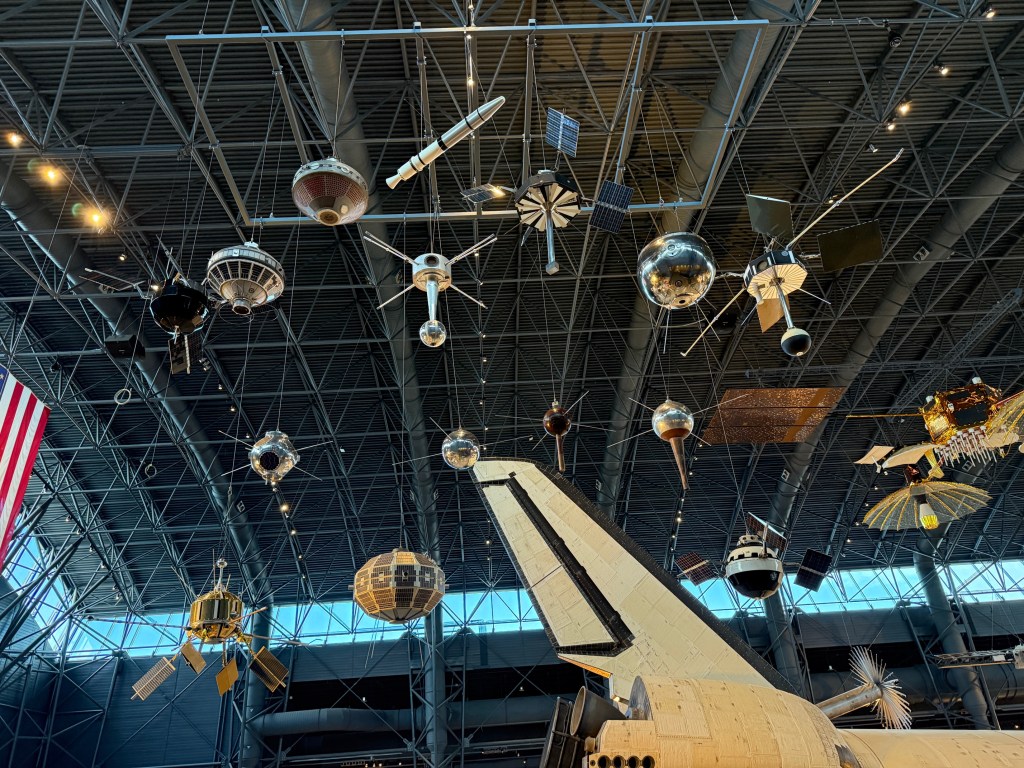
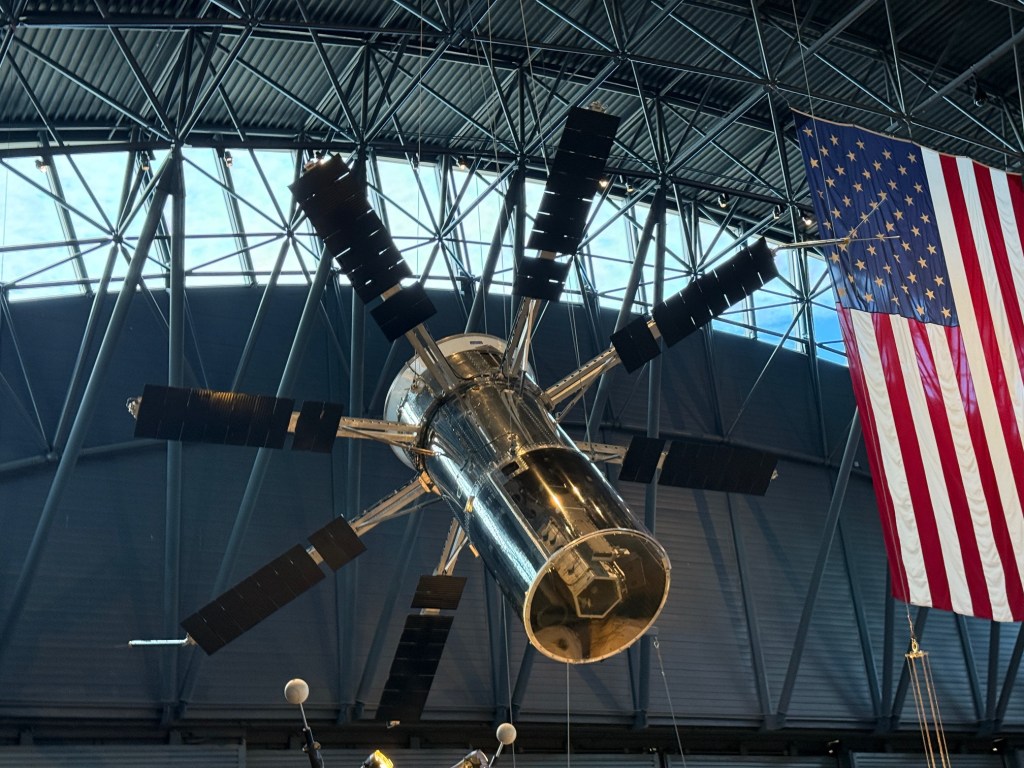
A large cylindrical spacecraft with “petal” solar arrays
This is a close-up of a cylindrical satellite/spacecraft with multiple rectangular solar panels extending outward like spokes.
What you’re seeing:
- A polished central body (the main spacecraft bus) that housed avionics, instruments, and communications gear.
- A ring of solar arrays mounted on booms—an older design language that prioritizes steady power while keeping panels clear of the body’s shadows.
- Structural trusses and attachment points that show how “spacecraft architecture” is as much mechanical engineering as it is electronics.
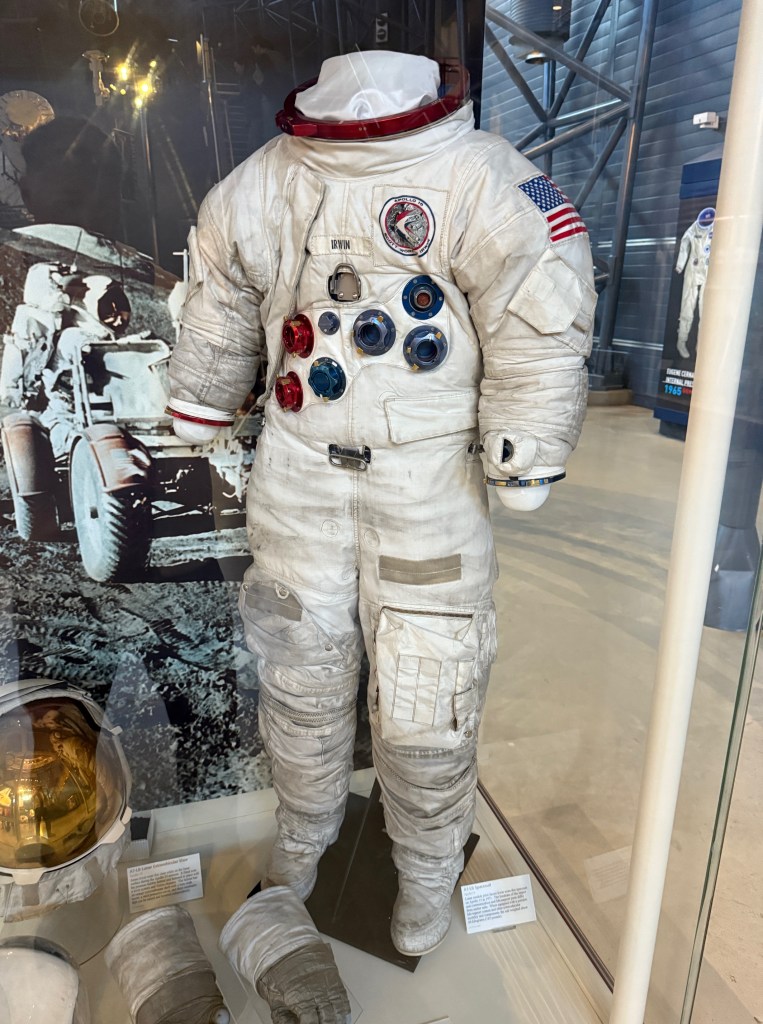
The spacesuit—the “capsule” you wear
A capsule keeps you alive for hours to days. A spacesuit is a personal spacecraft that does it at arm’s length from vacuum.
What’s visible:
- A white EVA-style suit with prominent connectors and valves on the torso—interfaces for oxygen, cooling, communications, and suit pressure management.
- Mission patches and hardware mounting points that hint at how tailored these suits were to specific programs and eras.
- The suit’s bulky joints and layers—evidence of the constant tradeoff between mobility and life support.
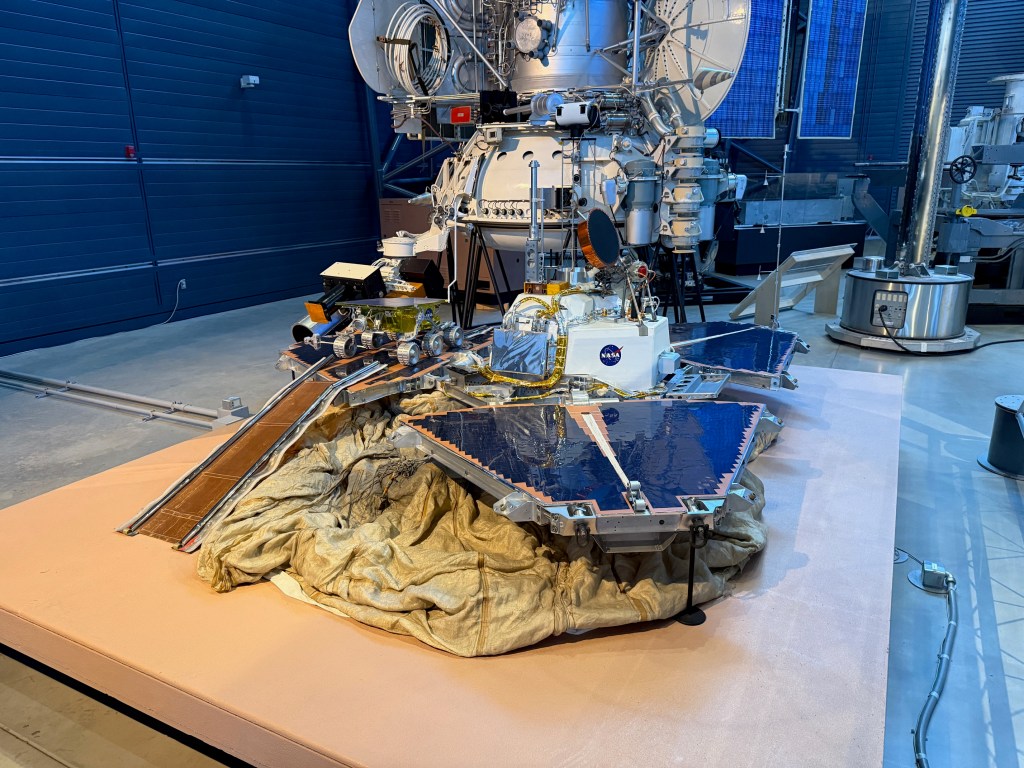
A Mars lander + rover display with airbags and solar panels
This display is a highlight because it captures a very specific moment in exploration history: when NASA proved you could land on Mars with a clever, robust trick—airbags.
What’s visible:
- The lander platform with blue solar panels laid out in a triangular/petal arrangement.
- The tan, wrinkled material around it: airbags used to absorb impact during landing (the “bounce and roll” method).
- A small rover-like vehicle nearby, this style strongly resembles the Mars Pathfinder / Sojourner era of design and demonstration.
Ingenuity—the “capsule era” gives way to powered flight on another world
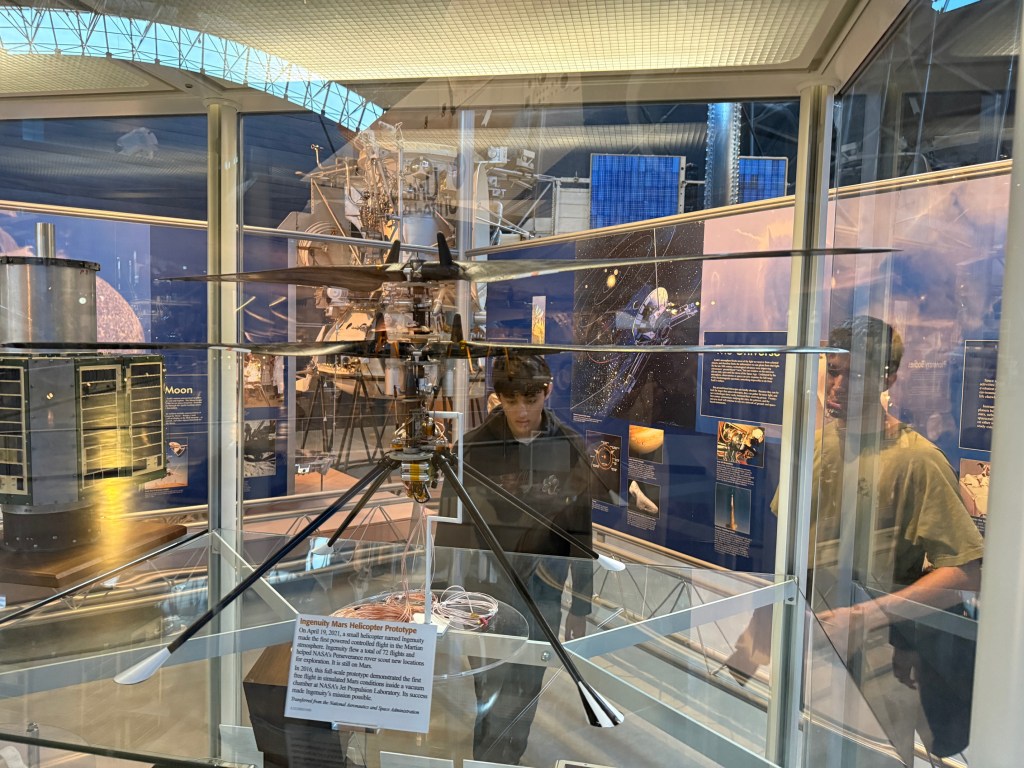
Inside the glass case is the Ingenuity Mars Helicopter prototype, one of the most inspiring “small hardware, huge meaning” artifacts of modern exploration.
What’s visible:
- The helicopter’s tall, lightweight frame and coaxial rotors (stacked rotor system), a necessity in Mars’ thin atmosphere.
- Spindly landing legs and exposed components—mass is everything when you’re flying on Mars.
- Exhibit text indicating it’s a prototype associated with the historic first powered flight on another planet.

 Astronomer Willy
Leave a comment