
After seeing the giant optical/near‑infrared Keck domes, it’s easy to assume every telescope up on Mauna Kea is chasing the same kind of light in the same way. JCMT and UKIRT are a great reality check: they both live on the summit because the site is dry, high, and stable—but they “see” the universe through very different parts of the spectrum, and that changes everything about what they’re built to do.
On Mauna Kea, altitude isn’t just about being above clouds. It’s about being above water vapor, which absorbs huge swaths of infrared and submillimeter radiation. The summit’s exceptionally low precipitable water vapor (PWV) on good nights opens atmospheric windows that are almost closed at sea level. That’s why Mauna Kea became a home not only for optical telescopes, but also for facilities that push into wavelengths where the atmosphere is normally an enemy.
JCMT: a 15‑meter dish that listens to cold dust and newborn stars
The James Clerk Maxwell Telescope (JCMT) is a 15‑meter telescope optimized for submillimeter astronomy (roughly a few hundred microns in wavelength). Submillimeter is a strange regime compared to visible light: you’re not primarily seeing starlight. You’re seeing cold dust grains glowing at tens of Kelvin, and emission lines from molecules in star-forming gas. In a way, JCMT is less like a “camera” and more like a thermal-and-chemical sensor for the parts of the universe that are otherwise hidden.
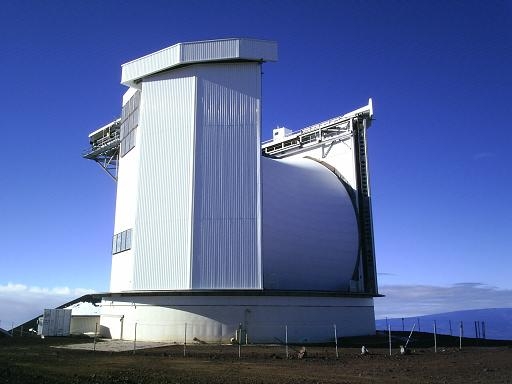
JCMT is named after James Clerk Maxwell, whose equations unified electricity and magnetism and predicted electromagnetic waves—basically the theoretical foundation that makes “observing different wavelengths” meaningful in the first place. The telescope began operations in the late 1980s and has been run under international partnerships, with major involvement from organizations such as the East Asian Observatory (EAO) in its modern era. Official site: https://www.eaobservatory.org/jcmt/
What makes JCMT historically famous is how it helped turn submillimeter astronomy from niche to mainstream—especially through its instruments. A legendary name you’ll hear constantly is SCUBA (Submillimetre Common-User Bolometer Array) and its successor SCUBA‑2. These are bolometer cameras designed to map faint submillimeter emission across the sky. SCUBA’s deep observations helped reveal populations of extremely luminous, dusty, high‑redshift galaxies—often called “submillimeter galaxies”—that were undercounted in optical surveys because dust blocks visible light but re-radiates in the submillimeter. SCUBA‑2 took that mapping capability to a higher level with larger-format detectors and faster surveys.
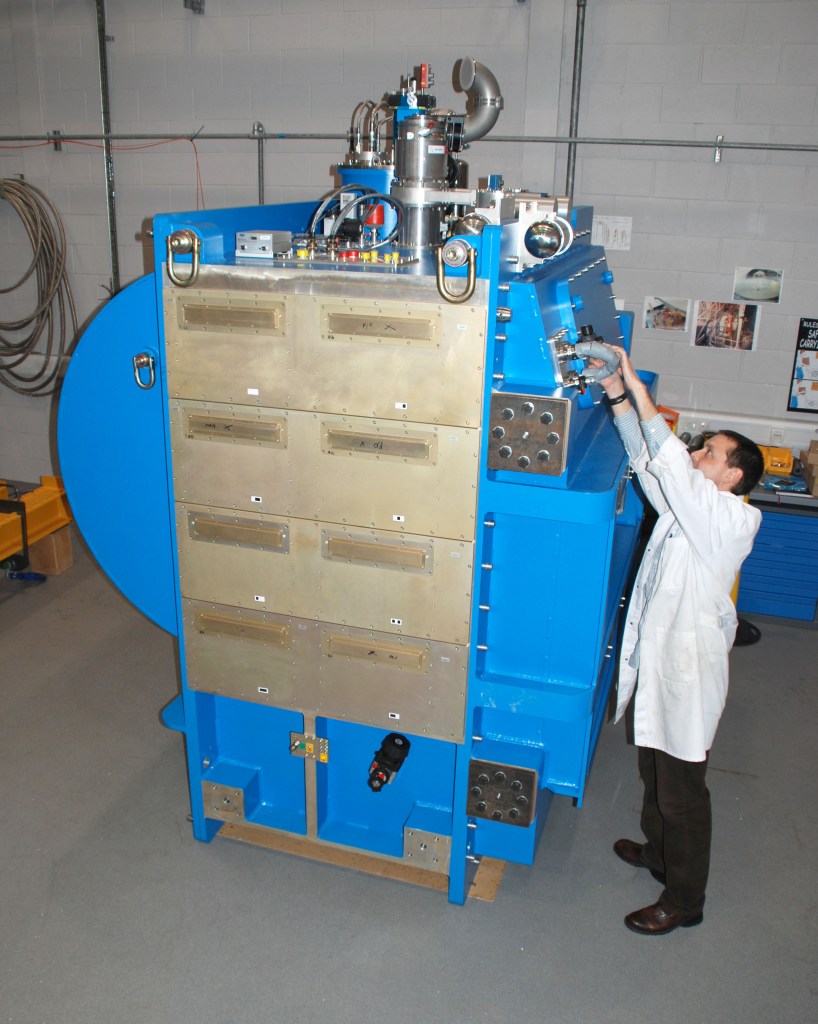
JCMT is also a chemistry machine. Instruments like HARP (a heterodyne array receiver) paired with spectrometer backends such as ACSIS enabled efficient mapping of molecular lines (for example CO transitions) across star-forming regions. Those line maps are not just pretty pictures; they let astronomers infer gas velocity fields, turbulence, outflows, and cloud structure, which are core ingredients in how stars form.
JCMT has also played a role in one of the most iconic astronomy projects of the last decade: the Event Horizon Telescope (EHT), which uses very-long-baseline interferometry (VLBI) at millimeter wavelengths to synthesize an Earth-sized virtual telescope. Mauna Kea is strategically valuable for VLBI baselines across the Pacific, and JCMT has been one of the participating stations in EHT-era observations. EHT overview: https://eventhorizontelescope.org/
What I found coolest as a student is that JCMT is not primarily about “one perfect image.” It’s about survey speed and mapping—covering big areas to build statistical samples of star-forming cores, dusty galaxies, and the structure of the interstellar medium. This is one reason JCMT data show up everywhere in modern astrophysics papers: it’s foundational context, like a weather map for the galaxy.
UKIRT: the wide-field near‑infrared workhorse
If JCMT is tuned to cold dust emission, the United Kingdom Infrared Telescope (UKIRT) sits in a different sweet spot: the near‑infrared (roughly 1–2.5 microns). UKIRT has a 3.8‑meter mirror—smaller than Keck, but historically extremely significant because it was built as a dedicated infrared facility. For years, UKIRT was the largest telescope in the world designed specifically for infrared observations, and it became famous for doing something that big telescopes don’t always do best: wide-field surveys.
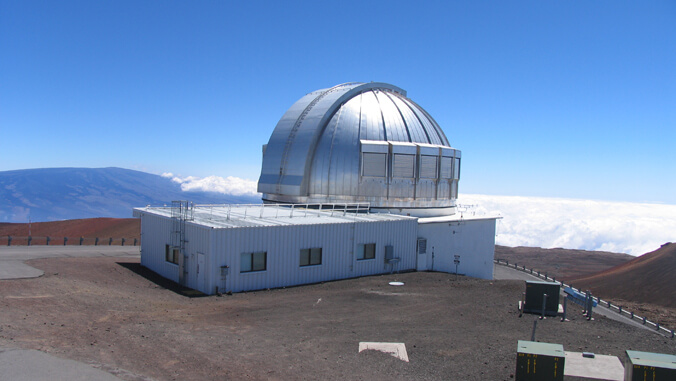
UKIRT began operations in the late 1970s. It was developed and operated for decades under UK stewardship (through organizations that later became part of STFC, the Science and Technology Facilities Council), and in the 2010s operational responsibility shifted to the University of Hawaiʻi. UKIRT info: https://about.ifa.hawaii.edu/facilities/ukirt/
Near‑infrared matters because it can see through dust better than visible light. Star-forming regions, the Galactic Center, and embedded young stellar objects often sit behind dust that makes optical images look like blank darkness. In the infrared, those same regions light up with stars, warm dust, and diagnostic spectral features. The near‑IR is also where cool objects—like brown dwarfs—are comparatively easier to detect.
UKIRT’s modern “superpower” came from WFCAM (the Wide Field CAMera), an instrument built to image a large patch of sky quickly at near‑IR wavelengths. WFCAM powered major survey programs such as UKIDSS (the UKIRT Infrared Deep Sky Survey), which created deep, wide infrared maps used for everything from identifying brown dwarfs to studying galaxy evolution and mapping the Milky Way’s structure. UKIDSS overview: https://www.ukidss.org/
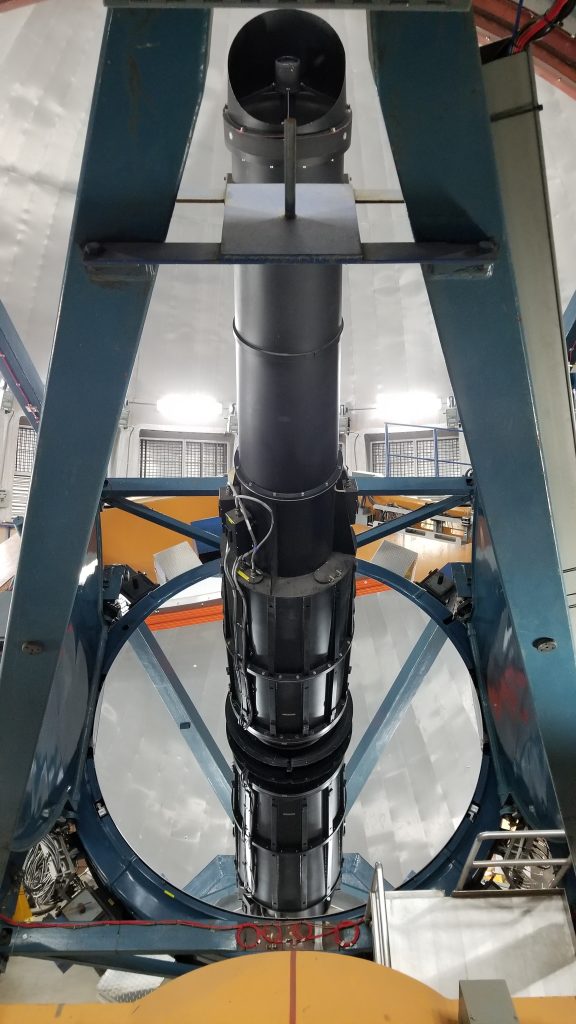
When you look at astronomy today, it’s hard to overstate how valuable these survey telescopes are. Giant telescopes like Keck do incredible, detailed follow-up—high-resolution spectroscopy, adaptive optics imaging, precise radial velocities. But surveys tell you where to look and provide the statistical context. UKIRT has been one of those engines of discovery: quietly generating catalogs that become the starting point for thousands of later studies.
Why these two telescopes belong together on Mauna Kea
Visiting in person made the “multi-wavelength” idea feel real. JCMT observes longer wavelengths that trace cold dust and molecular gas—basically the raw material and hidden activity of star formation and dusty galaxies. UKIRT observes shorter infrared wavelengths that penetrate dust and reveal stars, stellar populations, and the structure of the Milky Way and nearby universe. Put together, they show complementary layers of the same astrophysical systems.
Mauna Kea enables both because it offers a rare combination: high altitude, dry air, and enough infrastructure to support advanced instruments in harsh conditions. That’s why the summit isn’t just “a place with telescopes.” It’s a place where different parts of the electromagnetic spectrum are routinely turned into data, and where astronomy becomes a full-stack operation—from detectors and cryogenics to software pipelines and archival surveys.
In my next post, I’ll zoom out and focus on what all these Mauna Kea observatories do scientifically—how their research priorities differ, where they overlap, and how they collectively build a more complete picture of the universe than any single telescope could manage.


 Astronomer Willy
Leave a comment