
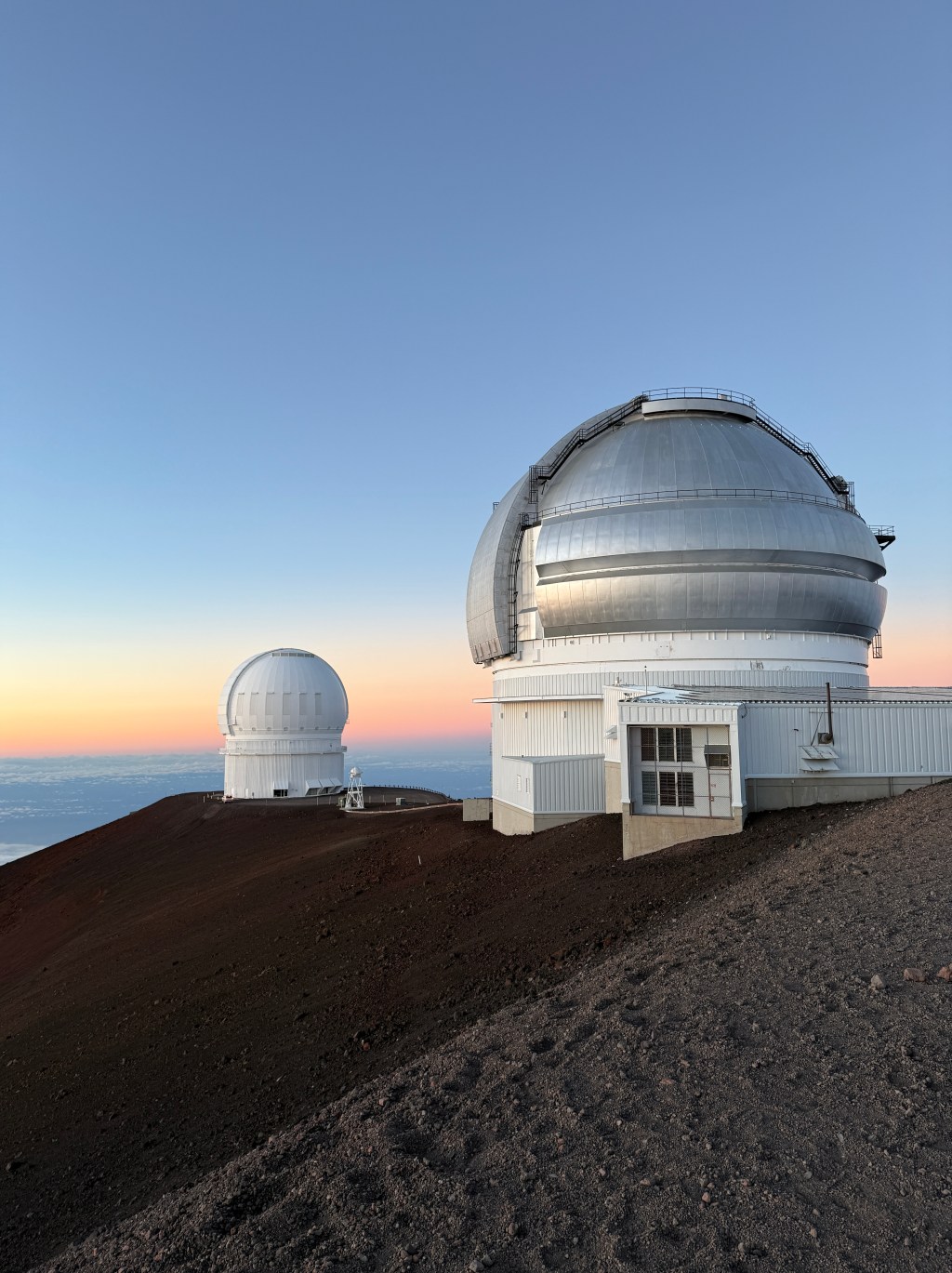
If the Mauna Kea summit feels like a sci‑fi film set, the W. M. Keck Observatory is the scene-stealer. Keck isn’t one telescope—it’s two: Keck I (first light 1993) and Keck II (first light 1996), each with a 10-meter primary mirror. For decades they have been among the most productive optical/infrared observatories on Earth, not because they’re simply large, but because their design and instruments are optimized to turn faint photons into precise measurements.
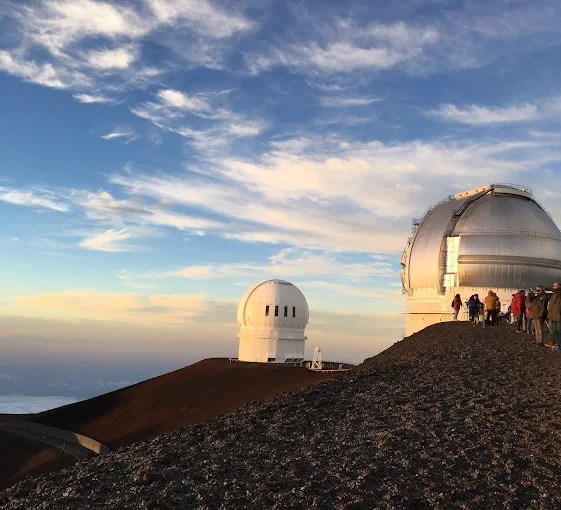
Keck’s origin story is a mix of ambitious engineering and philanthropy. The project was made possible by a major gift from the W. M. Keck Foundation (https://www.wmkeck.org/), and developed through a partnership led by the California Institute of Technology and the University of California. From the start, Keck aimed to break a perceived barrier: at the time, building a monolithic 10-meter mirror was extraordinarily difficult and expensive. Keck’s answer was bold and elegant—build a 10-meter-class telescope using segmented-mirror technology.
The mirror that changed the economics of giant telescopes
Each Keck primary mirror is made of 36 hexagonal segments, actively controlled so they behave like one continuous optical surface. This isn’t just a “big mirror made of pieces.” The segments must be aligned to nanometer-scale precision using a system called active control. Edge sensors measure how segments sit relative to each other, and actuators continually adjust their positions. In practice, Keck’s mirrors are living systems: they are constantly corrected to maintain a single, sharp figure as temperatures change and the telescope moves.
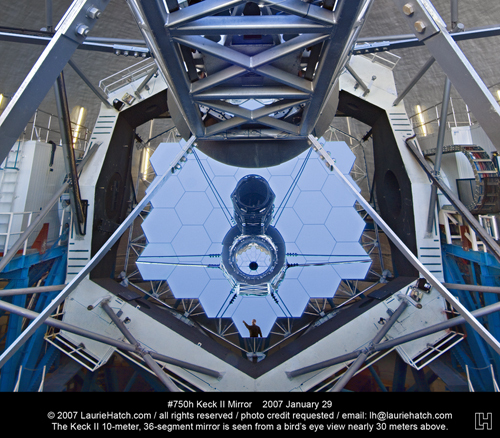
The twin Keck 10-meter mirrors are foremost among the world’s optical telescopes. Each is comprised of 36 hexagonal mirror segments placed edge-to-edge to form a continuous light-collecting surface of 76 square meters.
This architecture helped prove that segmented mirrors were a viable path to the next generation of telescopes. If you’ve heard of the Thirty Meter Telescope (TMT) or the Extremely Large Telescope (ELT), those projects owe a lot to what Keck demonstrated in the 1990s: you can build “impossibly large” apertures by controlling many precision segments as one.
More aperture does one critical thing for astronomy: it gathers more light. Light-gathering power scales with the area of the primary mirror, so a 10-meter telescope collects vastly more photons than a typical 1–2 meter university telescope. That’s the difference between “a faint smudge” and “a measurable spectrum,” especially in the infrared where targets can be dim and the sky background can be tricky.
Keck I vs Keck II: similar giants, different strengths
Keck I and Keck II are near twins mechanically, but their scientific personalities come from the instruments and adaptive optics systems installed over time. Think of the telescopes as high-precision “light buckets” feeding interchangeable scientific tools. Some tools are designed for imaging; others split light into its component wavelengths (spectroscopy), which is how astronomers learn composition, temperature, velocities, and more.
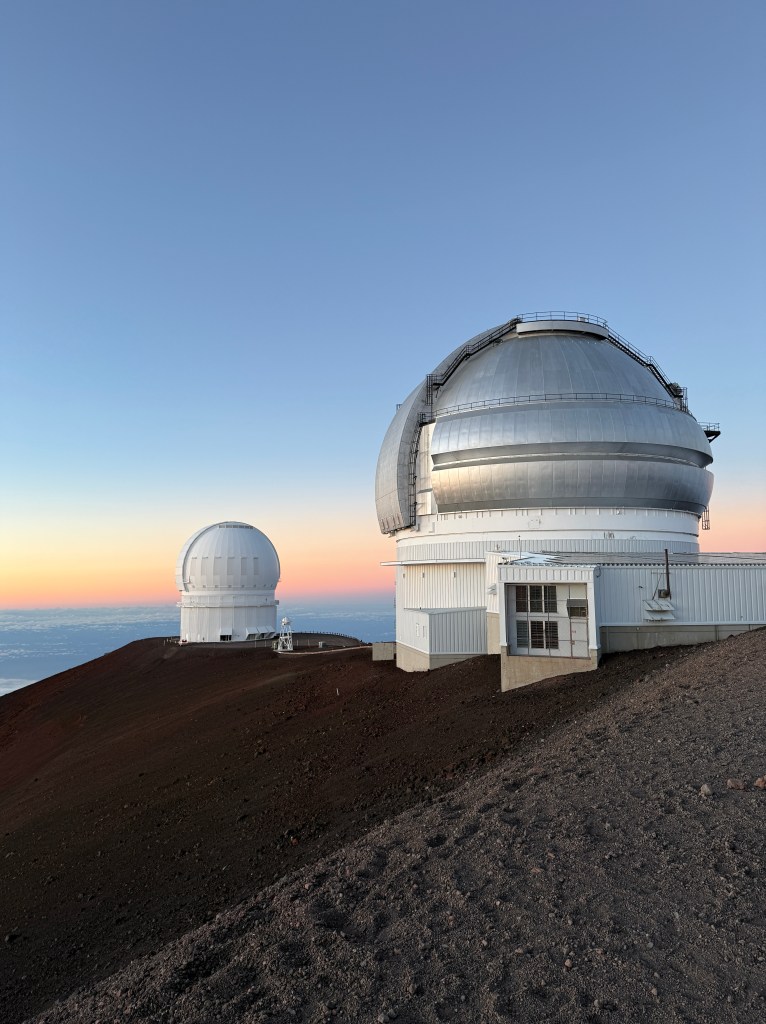
A particularly important capability at Keck is adaptive optics (AO): a system that measures atmospheric blurring in real time and corrects it by deforming a mirror many times per second. Without AO, Earth’s atmosphere often limits resolution; stars look like fuzzy blobs rather than diffraction-limited points. With AO, Keck can deliver extraordinarily sharp images in the near-infrared, approaching the theoretical limit set by a 10-meter aperture. Keck uses both natural guide star AO (when a bright star is nearby) and laser guide star AO, where a laser creates an artificial reference “star” in the upper atmosphere to enable correction almost anywhere in the sky.
If you want a real-world intuition: AO is like image stabilization plus real-time lens reshaping, except the “shake” is the turbulent atmosphere and the corrections happen hundreds to thousands of times per second.
Famous discoveries: from exoplanets to the Milky Way’s black hole
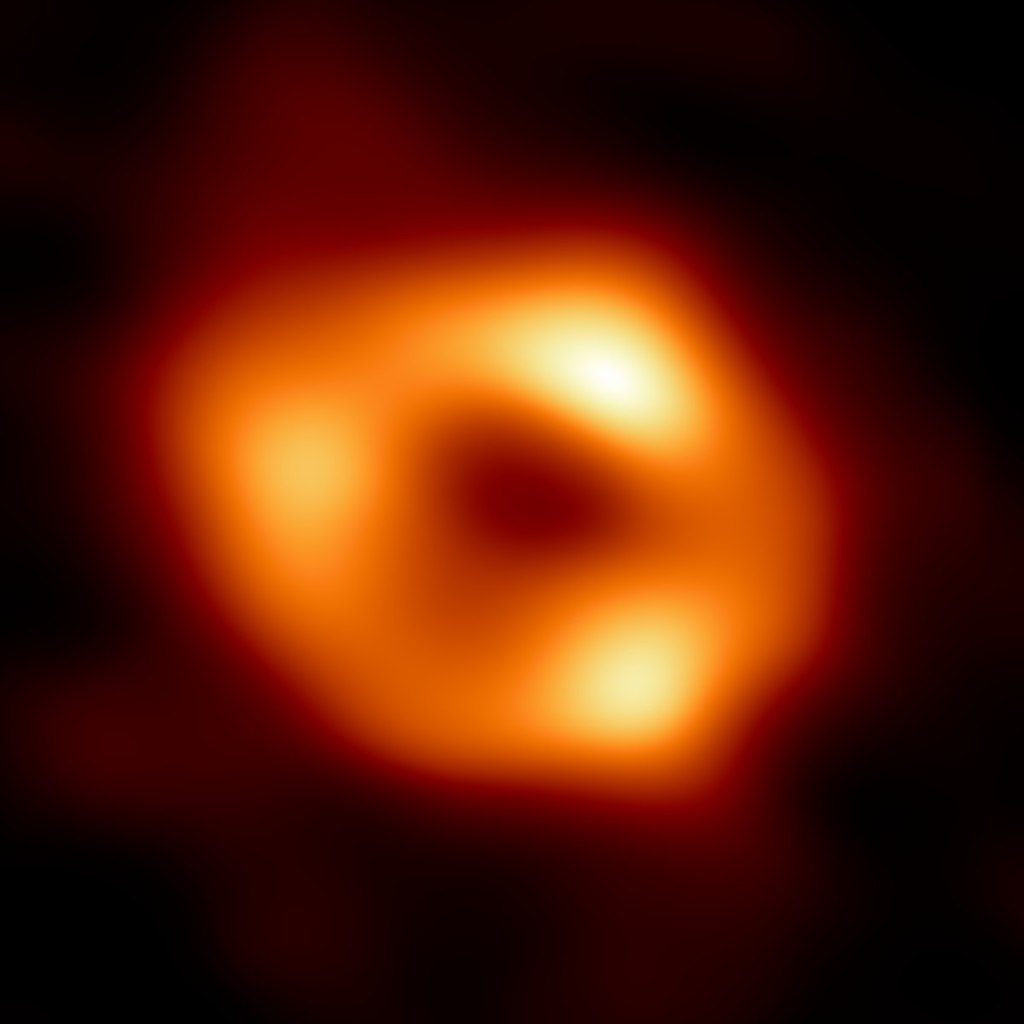
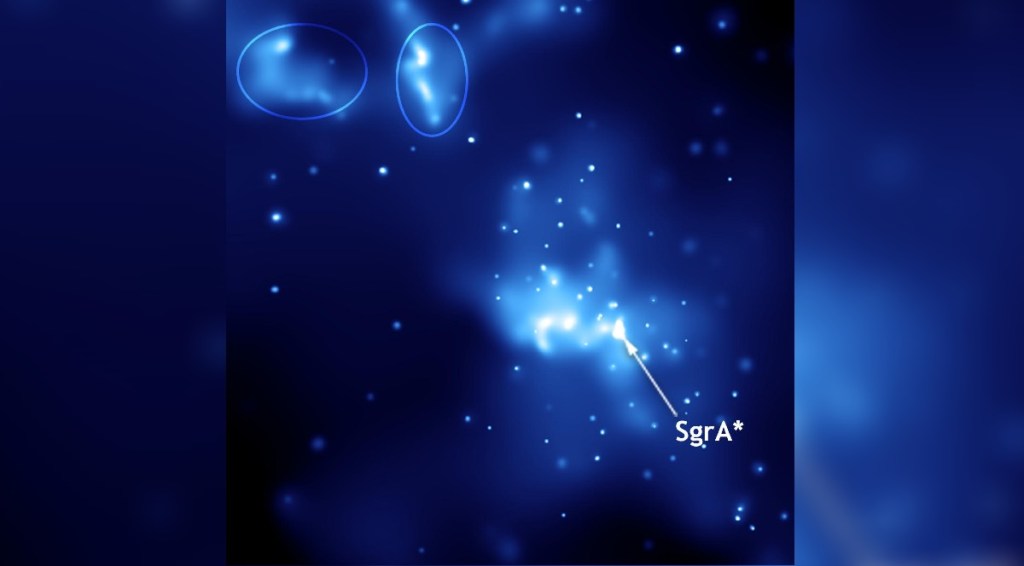
Keck’s most iconic scientific contribution is tied to the center of our galaxy. Using AO, astronomers tracked the orbits of stars around the radio source Sagittarius A* and showed that these stars are moving under the gravitational pull of a supermassive black hole. This work—led by teams including Andrea Ghez (UCLA) and Reinhard Genzel (Max Planck)—helped earn the 2020 Nobel Prize in Physics. Keck’s role here wasn’t just “a big telescope”; it was the combination of aperture, infrared capability (to see through dust), and adaptive optics resolution.
Keck has also been a powerhouse for exoplanet science, especially through high-precision radial velocity measurements. The instrument HIRES (High Resolution Echelle Spectrometer) on Keck I became one of the most influential planet-hunting spectrographs of its era, enabling detections and mass measurements of many exoplanets by measuring tiny Doppler shifts in starlight. Even in today’s space-telescope age, ground-based spectroscopy is essential for confirming planets, measuring masses, and probing atmospheres.
In galaxy evolution and cosmology, Keck’s spectrographs have been used to measure redshifts and chemical abundances of distant galaxies—essentially building a time-lapse of the universe by observing objects at different distances (and therefore different look-back times). Keck has also contributed to studies of dark matter through gravitational lensing and to the chemical archaeology of the Milky Way by analyzing the elemental fingerprints of old stars.
Keck Interferometer: combining two giants (and why it matters)
One of Keck’s most ambitious engineering efforts was the Keck Interferometer, which combined light from Keck I and Keck II to behave like a much larger “virtual telescope” for certain measurements. Interferometry is difficult because the light paths must be controlled to fractions of a wavelength; it’s like trying to keep two orchestras in perfect phase from miles apart. While the Keck Interferometer is no longer operating, it was a landmark demonstration of what’s possible when you treat telescopes as components in a larger optical system—and it influenced later interferometric and precision measurement projects.
Visiting Keck: what you notice when you’re there
From the outside, Keck’s domes look clean and minimal, but the real marvel is the idea that inside those shells, a machine the size of a building can point with arcsecond-level accuracy and hold a star steady on a slit narrower than a human hair at arm’s length. Everything is built around stability: structural stiffness, thermal control, vibration management, and software that choreographs telescope motion, dome rotation, instrument configuration, and detector readout as a single pipeline.
As someone fascinated by rockets and the future of space engineering, Keck felt like a different kind of launch system. Rockets move hardware into space; Keck moves information to Earth—photons that have traveled for thousands, millions, or billions of years, captured and converted into data you can analyze in a notebook.
Learn more (official sources)
For deeper technical and historical details, Keck’s own site is excellent: https://www.keckobservatory.org/
For a broad overview of AO concepts: https://en.wikipedia.org/wiki/Adaptive_optics
For context on the Nobel-winning Galactic Center work: https://www.nobelprize.org/prizes/physics/2020/summary/


 Astronomer Willy
Leave a comment